An Outlaw Pastor: Rob Bell
Rob Bell was born on August 23, 1970, to a family deeply committed to the evangelical movement in America. His father, a U.S. District Judge appointed to the federal bench by Ronald Reagan, worked with Jerry Falwell to found the Moral Majority, a political organization that played a key role in mobilizing conservative Christians in the 1980s.
After finishing high school, Rob went on to earn a bachelor’s degree from Wheaton College and, after feeling called to ministry, a Master of Divinity from Fuller Theological Seminary. As a young pastor, he was mentored by Ed Dobson at Calvary Church in Grand Rapids, Michigan, before starting Mars Hills Bible Church in 1999.
While his new church started with a few hundred people, within a few years it grew to over 10,000 for Sunday morning worship. By all metrics, Rob’s ministry was wildly successful, but at the same time he wrestled with difficult questions that emerged from deep study of the Bible and critical reflection on his own experience. Through this honest struggle, he eventually realized that he could no longer accept some of the central tenets of American evangelicalism, such as the infallibility of scripture. He also felt uneasy about the cozy relationship between evangelicals and neo-conservative politicians. As the insights kept coming, they had a cumulative effect that launched him on a new spiritual journey.
Authenticity became a hallmark of Rob’s ministry, shaping his preaching and teaching. He chose to be honest with his congregation about his spiritual questions and to preach only about what he had experienced firsthand. While some found his transparency refreshing, others found it threatening, leading to conflicts at Mars Hill. For example, in 2003 he delivered a message series on the equality of women, and some church leaders tried to have him fired. When he decided to empower women to serve in church leadership roles, worship attendance dropped by 2,000.
While these experiences were painful, Rob didn’t turn back. His relationship with Mars Hill reached a turning point in 2011 after the publication of Love Wins, a controversial book that questioned traditional teachings on hell. He was quickly labeled a heretic in evangelical circles and, within a year, decided to leave his church in Michigan to pursue other avenues of ministry in Los Angeles, California.
While many at Rob’s church lovingly supported his spiritual transformation, others were less encouraging. Before leaving Mars Hills, some wealthy church members tried to pressure him with money to return to the standard evangelical message, the old “we will take our money and leave if you don’t do what we want” trick. Remembering this betrayal, he said in an interview, “It broke me, but it also gave me this nuclear engine of resolve to keep going.”[i]
Rob has certainly landed on his feet, writing numerous books, preaching and teaching in sold-out auditoriums, broadcasting a popular podcast, and making Time Magazine’s list of the 100 most influential people. But this didn’t happen overnight, and it certainly wasn’t easy. He was treated horribly by people who once declared him their torchbearer, launching smear campaigns on television, radio, social media, and in public speaking. Some of the very people he led to Jesus called his faith into question, accused him of being a false teacher, and publicly protested his speaking engagements.
Amid all the hostility, Rob didn’t lash out in anger or check out in resignation. Rather, he remained true to himself, to his relationship with God, and to the values of the gospel as he understood them. In this way, he serves as a real-life example of someone who has walked the first path of the Quadratos; someone who has accepted the call to a new spiritual journey, struggled with fears of the unknown, navigated major change, and responded to hatred with compassion and equanimity. Regardless of what you think about the specifics of his teaching, Rob is a good example of how to follow Jesus in the face of betrayal.
Being Betrayed: Jesus
Most people, whether they regularly attend church or not, can tell you that Jesus was betrayed by a man named Judas. When we dive into the details of the story as recorded in the Gospel of Matthew, we discover some helpful lessons for the first path of the Quadratos.
One of these lessons is not to be surprised by betrayal. In a sense, it’s to be expected when we embark on a new spiritual journey that upends old ways of thinking, believing, and acting.
It certainly didn’t surprise Jesus. At the Last Supper, he said, “Truly I tell you, one of you will betray me.” Upon hearing this, the disciples became “greatly distressed” and said one after another, “Surely not I, Lord?” Jesus answered, “The one who has dipped his hand into the bowl with me will betray me” (Matthew 26:21-23). This clearly foreshadows Judas’ betrayal (vv. 14-16, 47-50), but Jesus knew Judas would not be the only one. In first-century Palestine, meals were typically served from a common bowl. Each person around the table would tear off a piece of bread, shape it into a scoop, and reach into the bowl for food. Since everyone at the Last Supper would have dipped their hand into the bowl, Jesus was not only foreshadowing Judas’ betrayal but also that of all his disciples.[ii]
We see this play out in the story of Jesus’ passion. He predicted that Peter would deny him three times (Matthew 26:33-34), and Peter did (vv. 69-75). He also predicted that all his disciples would desert him (v. 31), and they did. According to Matthew, none of the disciples were at the foot of the cross; only the women were.
Jesus he expected betrayal, which allowed him to prepare for it. Instead of being surprised and reacting compulsively to emotional triggers, he saw it coming and prepared to respond with intentional acts of love. In this way, he navigated between two common pitfalls.
First, Jesus did not retaliate in resentment.
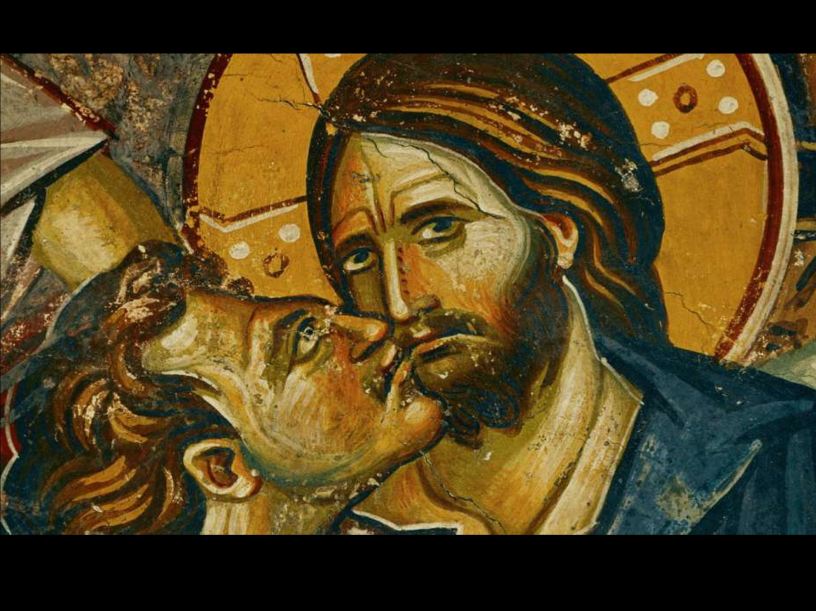
When Judas appeared in Gethsemane with a large crowd to arrest Jesus and then betrayed him with a kiss, Jesus said, “Friend, do what you are here to do.”
Did you catch that? Jesus addressed Judas as a friend, the man who sold him down the river for thirty pieces of silver. As Alexander John Shaia explains, “By using this address, he completely embodies the principles he taught in the Sermon on the Mount, returning nothing but the greatest love and respect even when it [was] not offered to him.”[iii] The betrayal didn’t change who he was—he remained true to himself and faithful to God. Instead of lashing out in punitive anger, Jesus responded with wisdom, compassion, and equanimity.
Second, when experiencing the pain of betrayal, Jesus did not disconnect from himself or from those who betrayed him to escape the hard work of reconciliation. How often do we do this? Someone betrays us, and we disconnect from ourselves through mindless distractions and from them by pretending they don’t exist. If we encounter them after the betrayal, it’s easy to ignore them in hopes that the conflict will simply go away. Isolation, denial, hiding, pretending, ignoring, and blaming are all attempts to escape the ongoing obligations of love.
But Jesus didn’t do this. He didn’t hide from those who betrayed him. Nor did he disconnect from himself, as shown when he hung on the cross and rejected the offer of gall (a bitter substance mixed with wine to deaden pain). He chose to remain fully awake, “to face and feel every moment with an open mind, heart, and body . . .”[iv] He stayed connected to his own experience so he could continue practicing the gospel in the presence of those who sought to destroy him.
Interestingly, the two pitfalls of lashing out and checking out are different ways of acting out a victim mentality. But Jesus would have none of this. Even in the depths of betrayal, humiliation, and suffering, he refused to see himself as a victim. He not only expected betrayal; he accepted it as a natural consequence of choosing the way of love in a fallen world.
In Luke 9:51, we read, “When the days drew near for him to be taken up, he set his face to go to Jerusalem.” In other words, Jesus made a deliberate decision to enter the holy city, knowing it would mark the beginning of the end. Resolute in his mission, he accepted the predictable consequences of speaking truth to power: betrayal, torture, and death. Likewise, in the Gospel of John, Jesus is recorded as saying, “No one takes [my life] from me, but I lay it down of my own accord” (10:18).
Since he refused to see himself as a victim, he had no need to punish people with anger or disconnect in fear. By refusing victimhood, he could continue acting intentionally in accordance with the law of love. This is a great example for us as we, too, experience betrayal on the first path of the Quadratos.
Like Jesus, we should expect betrayal so we can prepare for it. As we embark on new spiritual journeys, there will be people who try to pull us back into old ways of thinking, believing, and acting.[v] This pull can be gentle or forceful, and one forceful way to pressure someone is to betray them or accuse them of betrayal. This is especially true of authoritarian people who are plagued by the fear of losing control. The more fearful and insecure, the more authoritarian, demanding, judgmental, and punishing. So don’t be surprised when some people don’t celebrate your new journey and pressure you to go back to your old self. It is easier for them if you conform to the old pattern because then they don’t have to change and readjust to the new dynamic in your relationship. As you push through their resistance and continue moving forward, don’t be surprised when those same people betray you or accuse you of betraying them.
But be careful how you press forward and respond to betrayal. Remember the two pitfalls: betraying the very values of the spiritual transformation we seek by lashing out in anger and by disconnecting from those who hurt us in hopes of avoiding the ongoing obligations of love. Like Christ, we are called to forsake a victim mentality so we can intentionally choose to act with wisdom, compassion, and equanimity. This is no small order, and we fail all the time, but we must keep pursuing the way of Jesus Christ as part of our spiritual transformation.
As a note of caution, the law of love does not require us to be a doormat for the dysfunctional or a victim of abuse. God’s love cannot be separated from God’s justice, and loving someone involves telling them the truth (Ephesians 4:15). The same principle applies to reconciliation, which is possible only through mutual truth-telling and changed behavior. Consequently, submitting yourself to ongoing abuse is not an indication that you’re being faithful to the law of love but that you’re operating out of an unhealthy, self-destructive frame of mind. What is needed in these situations is emotional and spiritual healing, which almost always requires you to separate yourself from the abuser long enough to interrupt the dysfunctional system and gain enough health to make better choices. As many have learned the hard way, sometimes the most loving thing you can do for someone hellbent on destruction and abuse is to tell them goodbye.
Doing the Betraying: Peter and Judas
In conclusion, it’s important to offer a few words to those who have betrayed others. Just as Jesus said of the disciples, the same is true of us. At some point in life, we all betray someone (which should make us more compassionate toward those who betray us). Romans 3:23 says that everyone falls short of what God expects, another way of saying that we all succumb to the backward pull of our former life, causing us to betray Jesus, others, and ourselves. Like the disciples, we all become deserters. So how do we get back up, find our footing, and start walking the road to transformation again? Fortunately, the passion of Jesus in the Gospel of Matthew also provides guidance for this problem, especially as we consider the examples of Peter and Judas.
As already mentioned, Peter denied Jesus three times before Jesus was crucified. Can you imagine the pain he must have felt when the full realization of his unfaithfulness dawned on him? Can you imagine how uncomfortable Peter must have been upon seeing Jesus again after the resurrection?
Although he was deeply ashamed, he accepted responsibility for his failure. As he stood before the one he had betrayed, he found forgiveness rather than judgment, reconciliation rather than condemnation. As with us, it was probably easier to receive forgiveness from Jesus than to forgive himself, but by the grace of God, Peter was able to do just that—and it saved his life.
This part of the story reminds us that even in the worst betrayals, there remains the possibility of forgiveness and redemption for those who stay close to God and are willing to do the difficult work of reconciliation. We see this played out not only in the life of Peter but also in the lives of all the disciples, except Judas. All betrayed Jesus, and all were forgiven and restored.
Just as all the disciples became deserters, we all become deserters too. It’s almost as if failure is built into the first path of the Quadratos. When we embark on a new spiritual journey, we all begin in weakness, confusion, and fear, and we must learn the lessons our unfaithfulness teaches. After all, how can we proclaim the good news of forgiveness unless we have been recipients of this gift ourselves?
It’s important to keep all these gospel truths in mind because if we don’t, they can kill us.
Like Peter and the other disciples, Judas betrayed Jesus too. We sometimes think of Judas as the only one or assume his betrayal was worse than the others’. But I don’t think so. Betrayal is betrayal, and if Judas had returned to Jesus after the resurrection and asked for forgiveness, I think Jesus would have embraced and restored him, just as he did with the others. So why did it turn out so differently for him?
I think it has to do with self-hatred. After betraying Jesus, Judas became the victim of his own despair. For whatever reason, he didn’t believe in Jesus, and I’m not talking about the kind of believing in which you receive Jesus as your personal savior. I mean he literally didn’t believe Jesus’ message about God’s love, forgiveness, and reconciliation. It’s true that Judas felt horrible after coming to terms with what he had done, which led him to repent and return the blood money to the religious leaders. However, when he realized that this act of contrition could not stop the destruction he had set in motion, he descended into a dark pit of self-loathing. He could not imagine Jesus forgiving him. He could not imagine forgiving himself. So he went into the woods and killed himself (Matthew 27:3-5).
Like Judas, we too can descend into a pit of despair after betraying someone we love. Self-hatred can blind us to the possibility of forgiveness and rob us of the hope of the gospel. As Dante knew, this is the definition of hell, a place devoid of hope. Once we lose hope, we experience death—spiritually, emotionally, and sometimes even physically. This is why believing in Jesus is a matter of life and death for many people.
Challenge
As we navigate change on the path to transformation, we encounter resistance. Will we choose to keep walking even when those around us do not? Even when they pressure us to return to old ways of thinking and betray us when we conform? Will we choose to stay attuned to our experience and remain connected to others, even as we confront our fears and the death of the ego? Will we let go of resentment and choose love, acting with wisdom, compassion, and equanimity? Will we forgive others, remain open to reconciliation, and attend to the ongoing obligations of love? Will we believe the promises of Jesus, accept God’s forgiveness, and learn to forgive ourselves when we are the ones who have failed?
Continue the Journey
If this article was meaningful to you, I’d love to stay connected. To receive future articles, devotionals, and reflections, enter your email address in the subscription box on the sidebar and click “Subscribe.”
You can also watch sermons or listen to my podcast for additional helpful messages:
Pastor Mark Reynolds is the author of the forthcoming book What Christians Do: Living Like Jesus in a Divided World (October 2026), exploring practical ways Christians can embody the character and teachings of Jesus in today’s world.
(This post is the seventh in a series of thirty-seven in conversation with the book Heart and Mind by Alexander John Shaia. Each post is a revised version of a sermon, which can be accessed on YouTube and iTunes.)
Notes
[i] The Hell-Raiser, video uploaded on The New Yorker, “A Megachurch Pastor’s Search for a More Forgiving Faith,” December 16, 2016. https://www.newyorker.com/culture/culture-desk/a-megachurch-pastors-search-for-a-more-forgiving-faith. See also the documentary, “The Heretic.”
[ii] Alexander John Shaia, Heart and Mind: The Four-Gospel Journey for Radical Transformation, Second Edition, Journey of Quadratos, LLC: Santa Fe, New Mexico 2017, pp. 103-104.
[iii] Heart and Mind 107.
[iv] Heart and Mind 113. Matthew 27:34.
[v] One way of illustrating this can be found in family systems theory. In all groups, individuals assume different roles and then relate to each other in ways that aim at homeostasis, a stable equilibrium between the various roles. Since homeostasis is determined by the predictable interactions of all the various roles people play, when one person decides to change, it not only affects that individual but throws the whole system out of whack. Great pressure is exerted on the individual to go back to their previous role so that the system can be restored to balance. Whether it’s your family, church, or small group, if someone decides to deviate from their role, then people in that group will almost inevitably make efforts to pull that person backwards.

