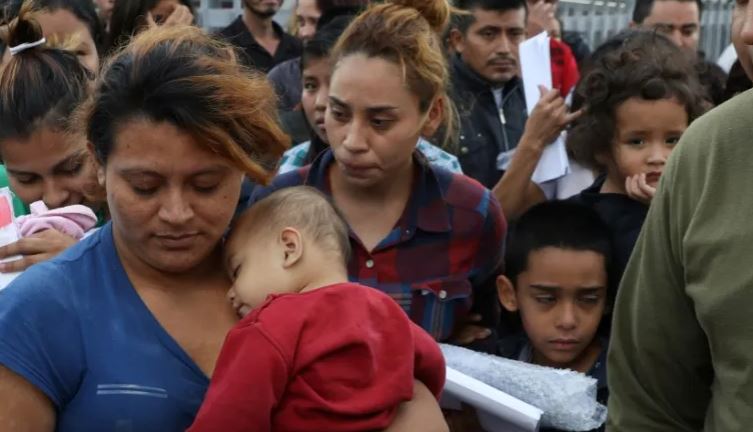
A Moral Crisis Facing the Church
Some are asking whether the United States is teetering on the edge of a constitutional crisis. But as a Christian theologian, I believe the more urgent and consequential issue is the profound moral crisis facing the American church. While headlines focus on economic anxiety—like rising tariffs—or protests outside Tesla dealerships, the defining moral issue of our time is how our government treats immigrants. Every follower of Jesus Christ, and every serious student of Scripture, should be deeply concerned and actively resisting any unjust and inhumane treatment of immigrants in our country.
There have only been a handful of moments in my ministry when I felt compelled to speak publicly on an issue that strikes at the very heart of the Christian faith. This is one of those moments.
To remain silent would, for me, be to risk compromising my own soul.
While I reject the politicization of moral issues, this is not a partisan critique—it is a deeply biblical and theological appeal. It is a call for our politics to submit to the Lordship of Jesus Christ and for our nation to repent of actions that history will almost certainly judge as atrocities.
My intended audience is not the hardened Christian nationalist—though I pray for them too—but the thoughtful believer who has not fully surrendered their conscience to ideology. I am speaking to those willing to step back, resist the reflex to defend partisan power, and honestly reflect on what is unfolding before our eyes—in the detention centers, on deportation flights, in foreign prisons, and in the streets of America.
From El Salvador to the U.S.: Inhumane Immigration Practices
On March 27, 2022, Salvadoran President Nayib Bukele—long criticized for authoritarian tendencies—launched a sweeping crackdown on gang activity following a sudden spike in homicides. In response, his government declared a state of exception, suspending key constitutional protections, including the right to due process. Under this emergency decree, security forces carried out mass arrests, often without warrants or credible evidence. By March 2025, more than 85,000 people had been detained, many without formal charges, trials, or access to legal counsel. Reports indicate that arrests were frequently based on superficial traits—such as tattoos or social media activity—rather than substantiated criminal behavior. To manage the surge in detentions, Bukele’s administration built the Terrorism Confinement Center (CECOT), a massive high-security prison designed to house up to 40,000 inmates. Thousands remain incarcerated there under indefinite and inhumane conditions.

El Salvador’s CECOT has drawn international condemnation for conditions that many human rights experts describe as cruel, degrading, and in violation of international law. Cells designed for far fewer occupants now hold between 65 and 150 individuals, leaving each person with less than 0.6 square meters of space—well below the minimum standards set by the United Nations. Prisoners sleep on bare metal bunks without mattresses or bedding, and each overcrowded cell is equipped with only two toilets and two sinks, regardless of how many detainees it holds.
Inmates at CECOT, are never allowed outside. The facility is illuminated by bright artificial light 24 hours a day, disrupting natural sleep cycles and contributing significantly to psychological distress. Prisoners are confined for 23.5 hours each day, with only 30 minutes allotted for exercise—conducted in enclosed corridors without access to sunlight or fresh air. Most detainees are denied legal representation and barred from receiving visits from family members, cutting them off from their support systems and deepening their isolation.
Since CECOT’s inauguration in early 2023, there have been no confirmed reports of any inmate being released. Operating under a state of exception that suspends due process and allows for indefinite detention without formal charges or trials. Under current conditions and policies, the possibility of release for many detainees appears increasingly remote—raising urgent moral questions about the long-term human cost of such a system.
Multiple human rights organizations, including Amnesty International and Human Rights Watch, have documented systematic patterns of abuse within CECOT, including torture, prolonged solitary confinement, and inhumane treatment. These findings have sparked widespread international condemnation. Many legal experts and humanitarian observers conclude that the conditions at CECOT are likely to violate international law, specifically the United Nations Standard Minimum Rules for the Treatment of Prisoners.
Under current U.S. law, a prison like CECOT could not legally operate. Its conditions are so extreme that even the most violent offenders in American maximum-security prisons are protected from such treatment by constitutional and statutory safeguards. In fact, when El Salvador began detaining tens of thousands of people without trial in 2022, critics across the U.S. political spectrum condemned President Bukele’s actions as a dangerous descent into authoritarianism.
Yet today, what was once decried as the cruelty of a foreign strongman has become official U.S. policy. Through an aggressive—and arguably unconstitutional—use of the Alien Enemies Act, the 47th President of the United States has authorized the mass deportation of immigrants, including many with no criminal record, to El Salvador. There, they are imprisoned indefinitely and without due process in facilities like CECOT. The administration appears determined to outpace the courts, exploiting speed and secrecy under the banner of national security—while sacrificing the rule of law and the lives of the vulnerable.
Even more disturbing, the United States is not merely imitating Bukele’s tactics—it is outsourcing and funding them. American taxpayer dollars are now being used to pay the Salvadoran government to do on our behalf what would be illegal on U.S. soil: violate the constitutional and human rights of vulnerable immigrants. Just as Bukele’s regime relied on guilt by association—tattoos, neighborhoods, or social media posts—as grounds for indefinite detention, the U.S. government is now invoking emergency powers and sweeping generalizations to justify a mass purge of non-citizens, many of whom have never been charged with a crime. This is not merely an administrative failure—it is a profound moral collapse, echoing the very authoritarianism we once claimed to oppose. It’s not just a political scandal; it is a moral crisis demanding the full attention and response of the Church.
The Image of God and the Inviolable Worth of Every Person
Some will argue that violent gang members who are in our country illegally are simply getting what they deserve—that imprisonment alongside other violent offenders is a just outcome. But even in the case of the most hardened criminals, our laws do not allow us to strip them of their basic human rights. Due process and humane treatment are not optional; they are legal and moral obligations. And for Christians, these are not privileges granted by governments—they are inalienable rights bestowed by the Creator. This conviction is rooted in the foundational belief that every human being is made in the image of God (Genesis 1:27), and therefore deserving of dignity, justice, and mercy.
No matter how evil a person’s actions may be, they are still a human being—still a beloved child of God.
Even if we regard them as enemies—even enemies of the state—Jesus calls us to love our enemies. At the very least, to love someone means refusing to facilitate their abuse or torture. To subject anyone to inhumane treatment—or to outsource that abuse by rendering them to a foreign government and funding that government to do what is illegal for us to do—is not only morally indefensible; it is theologically sinful. It is, quite plainly, evil.
To participate in or remain silent about such treatment is to violate not only our national ideals, but to stand in direct opposition to Christ himself. It is, in the truest sense of the word, anti-Christ. I cannot fathom how anyone who genuinely follows Jesus—and who has internalized his teachings in the Gospels—could justify such cruelty or turn a blind eye. This is not merely a political or humanitarian crisis. It is a crisis of discipleship.
From Lawful Status to Legal Abandonment: Case Studies in Injustice
What’s even more horrific is that, despite public statements claiming to target gang members and violent offenders, the current administration has vastly expanded its deportation net to include asylum seekers, legal residents, and immigrants with no criminal history. Many are being forcibly removed without due process and sent to foreign prisons—fully aware they will be confined alongside some of the most dangerous criminals in the world and subjected to unimaginably cruel conditions.

One of the most alarming examples is the case of Kilmar Abrego García, a Salvadoran national who had been living legally in Maryland under a “withholding of removal” status granted in 2019 due to credible fears of persecution if returned to El Salvador. Despite these legal protections, Abrego García was deported back to El Salvador in March 2025 after being accused of MS-13 gang affiliation—a claim based on circumstantial evidence such as tattoos and clothing, and unsupported by any criminal convictions. The U.S. Supreme Court later ruled his deportation illegal and ordered his return, but the administration has refused to comply, citing its inability to secure his release from Salvadoran custody.
Upon arrival, Abrego García was unjustly imprisoned in CECOT with dangerous, degrading, and inhumane conditions. His wife and children continue to plead for his release. His case is not an outlier—it is a warning. It shows how easily a person with legal protections and no criminal history can be torn from their family, cast into a foreign prison, and subjected to inhumane treatment in the name of security and political expediency.
In the same month, the U.S. deported 238 Venezuelan migrants to El Salvador, where they were detained in CECOT without trial. Investigations revealed that approximately 75% of these individuals had no criminal records in the U.S. or their home countries.[i]
Additionally, there have been instances where U.S. citizen children were deported alongside their undocumented parents. For example, four young children, all US Citizens, were deported to Mexico with their parents, including a 10-year-old girl who is recovering from brain cancer.

In another instance, two U.S. citizen siblings, a 4-year-old and a 7-year-old, were deported with their undocumented mother to Honduras within 24 hours after being detained. The 4-year-old boy has late-stage cancer and was deported without his medication.[ii]
These cases underscore the profound human impact of current immigration enforcement policies, raising serious concerns about due process, family separation, and the treatment of individuals within detention facilities.
We must not lose sight of the fact that these are human beings. Regardless of whether they have committed crimes or entered the country without documentation, their legal status does not change their intrinsic worth. They are human beings, created in the image of God, and they deserve to be treated with dignity, justice, and compassion—not primarily because of national or international law, but because of divine law.
Scripture’s Unwavering Witness: Justice for the Immigrant
As Christians we are bound by a clear biblical mandate to pursue justice and show grace to the immigrant. Scripture does not permit us to dehumanize, discard, or ignore them. Instead, it calls us to remember our shared humanity and to extend the very mercy we ourselves have received from God.
From Genesis to Revelation, the Bible reveals a consistent moral theme: how we treat the outsider, the vulnerable, and the immigrant lies at the very heart of God’s vision for human community. In a time when immigration is often reduced to partisan rhetoric and political scapegoating, the church must reclaim this sacred responsibility—not as a peripheral concern, but as a central expression of our discipleship and witness to the Gospel.
In the Old Testament, God repeatedly commands Israel to welcome and protect the immigrant. This isn’t just a social policy—it’s a theological mandate grounded in Israel’s own story of suffering and deliverance:
“Don’t oppress an immigrant. You know what it’s like to be an immigrant, because you were immigrants in the land of Egypt.” (Exodus 23:9, CEB)
The Hebrew word for “immigrant” in this verse is gēr (גֵּר), and it broadly refers to a “sojourner,” “resident alien,” or “foreigner” living in Israelite society without full rights of landholding or kinship. Israel began as an immigrant people. The patriarchs—Abraham, Isaac, and Jacob—are all described as gērim (sojourners) in Canaan (cf. Genesis 23:4; 26:3). Later, Israel becomes a nation of immigrants in Egypt (Exodus 1:1–7) and endures exile and foreign domination under Assyrians, Babylonians, Persians, Greeks, and Romans throughout much of its biblical history. They knew firsthand what it felt like to be displaced and vulnerable, and just as God had compassion on them and cared for them in their time of need, God commands Israel to extend that same compassion to the immigrant. This develops into a robust ethic of care—not confined to a few scattered verses but appearing in over 30 instances explicitly tied to social ethics, protection, or justice (e.g., Deuteronomy 10:18–19, 24:17–22, Exodus 22:21, Leviticus 19:10, Jeremiah 7:6). It is among the most frequently repeated ethical commands in the Torah. And as we will see, this ethic is not limited to ancient Israel—it extends to all of God’s people, including those who follow Jesus today.
As we return to the defining narrative of the Hebrew Bible, the Exodus in which God liberates His people from oppression in Egypt, we see that God hears the cry of the oppressed, has compassion on them, and acts on their behalf:
“I have observed the misery of my people… I have come down to deliver them” (Exodus 3:7–8).
Biblical scholar, John Dominic Crossan, writes: “The Exodus story is about the God who hears the cry of the oppressed… It is this foundational story that undergirds biblical ethics.”[iii] In a society shaped by this story, welcoming the immigrant is not charity—it’s what is required to remain faithful to God.
Consequently, the prophets of Israel had harsh words for nations that abused immigrants and the poor. They didn’t see injustice as a mere oversight but as a violation of the covenant, stirring up God’s wrath.
“They oppress the immigrant, the orphan, and the widow… and yet come and stand before me in this house.” (Jeremiah 7:6–10)
“The people of the land have oppressed the poor and needy, and have extorted from the alien without redress.” (Ezekiel 22:29)
Walter Brueggemann explains, “Injustice to the alien and vulnerable is not simply bad behavior; it breaks the covenantal fabric and brings about societal collapse.”[iv] This reminds us that the Bible does not separate spiritual life from social life. When a society treats immigrants with contempt, that society stands under divine judgment.
The New Testament continues and deepens this biblical concern. Jesus begins his earthly life as a refugee, fleeing political violence:
“Joseph took the child and his mother by night, and went to Egypt.” (Matthew 2:14)
Later in his adult ministry Jesus gives the parable of the sheep and the goats (Matthew 25:31–46) that describes the final judgment. Those on his right (the sheep) are welcomed into God’s kingdom because they showed compassion—feeding the hungry, clothing the naked, visiting the sick and imprisoned, and welcoming the stranger. Jesus says, “I was a stranger and you welcomed me.” Those who failed to do these things are sent away, having rejected Christ by ignoring the needs of others. The parable teaches that caring for the stranger is a direct expression of our love for Christ.
In this parable, the Greek word used for “stranger” is xenos, which refers to someone foreign, unfamiliar, or socially different—often a vulnerable outsider in need of hospitality. This term closely parallels the Hebrew word gēr (גֵּר) mentioned above which describes a non-Israelite residing in Israel without full rights—a resident alien. While xenos and gēr come from different languages and eras, they both function to highlight the presence of the outsider as a moral test for the faith community. Jesus’ use of xenos draws directly on the Jewish prophetic tradition, but with a profound theological intensification: to welcome the stranger is to welcome Christ himself. In doing so, Jesus deepens the Old Testament command, transforming hospitality to immigrants from a moral obligation into a sacred encounter with the divine.
Continuing this prophetic legacy, the Apostle Paul reminds the early Christian community:
“You are no longer strangers and aliens, but citizens with the saints and members of the household of God” (Ephesians 2:19).
As N.T. Wright explains, for Paul, the gospel creates a new humanity—one in which ethnic, national, and social boundaries are broken down in Christ. In this new community, there are no outsiders. The church, therefore, is not called to fear the immigrant, but to welcome them as fellow image-bearers of God and co-heirs of grace. To do anything less is to betray the very gospel we claim to proclaim.
The Book of Revelation, though often misunderstood as a cryptic end-times manual, powerfully affirms God’s ultimate vision of justice, inclusion, and redemption—especially for the oppressed and displaced. Written to persecuted Christians living under Roman imperial rule, Revelation offers a prophetic critique of empire and a hope-filled vision of a new world where the marginalized are no longer forgotten. The final vision of the New Jerusalem is striking in its openness: its gates “will never be shut” (Revelation 21:25), and the nations are not excluded but welcomed, their glory and honor brought into the city (21:24–26). The tree of life stands at the center of this renewed creation, offering healing “for the nations” (22:2), a vivid image of restoration for all people regardless of race, status, or origin. This vision stands in sharp contrast to systems that exile, exclude, and oppress. In Revelation, God’s kingdom is not built on the fear of the foreigner but on the embrace of every tribe, tongue, and nation. It proclaims that the Lamb who was slain stands in solidarity with all who suffer under unjust powers and calls the church to do the same. Ultimately, Revelation declares that God’s plan for humanity includes not walls or exclusion, but radical welcome, protection, and redemption for all—especially the vulnerable and displaced.
The Church’s Call: Repent, Remember, and Reclaim Our Witness
When we demonize immigrants or turn our backs on the vulnerable, we grieve the heart of God. In Isaiah 58, God calls the people not to empty religious performance, but to true repentance expressed through justice and compassion:
“Is not this the fast that I choose: to loose the bonds of injustice… to share your bread with the hungry, and bring the homeless poor into your house?” (Isaiah 58:6–7).
Genuine repentance means more than personal sorrow, it means facing the truth and choosing a different path. As Walter Brueggemann puts it, “Repentance in biblical faith means facing the truth of injustice and reorienting one’s life toward God’s justice.”[v]
It is important to be clear: the call to love and care for the immigrant does not mean advocating for open borders or abandoning the rule of law. We are a nation of laws, and we have a legitimate right—and responsibility—to maintain reasonable immigration policies that protect our national security and uphold the integrity of our democratic process. We must enforce these laws in a way that is fair, transparent, and consistent with our constitutional values, including due process. We should encourage people to come to the United States through legal pathways, and we have the right to deport individuals who break our laws and pose legitimate threats to public safety. But none of this gives us permission to act unjustly. As Christians, we must resist any immigration policy that violates biblical principles, dehumanizes those made in the image of God, or abandons the vulnerable. We must not support policies that tear children from their parents, deny protection to Dreamers, or refuse safe harbor to refugees and asylum seekers whose lives are in imminent danger. We can have a strong and secure immigration system—one that takes seriously the dangers of illegal immigration—while still acting with humanity, compassion, and justice. Anything less is not worthy of a nation that claims to value life, liberty, and the pursuit of justice for all.
A Test of Faithfulness
Scripture is clear: how we treat immigrants is a central test of faithfulness. It is not enough to pray, preach, or attend church. If our faith does not include compassion, welcome, and justice for the stranger, then it is not biblical faith. The author of Hebrews exhorts us:
“Do not neglect to show hospitality to strangers, for by doing that some have entertained angels without knowing it” (Hebrews 13:2).
In this moment of deep polarization, the church must recover its identity as a people shaped by the memory of deliverance, the ethic of compassion, and the witness of justice. We will stand before God and give an account—not only for how we treated our friends and neighbors, but for how we treated “the least of these,” which surely includes the immigrant, even the one labeled as a criminal.
Biblical and Theological Sources
- Brueggemann, Walter. The Prophetic Imagination. 2nd ed. Fortress Press, 2001.
- Brueggemann, Walter. Truth Speaks to Power: The Countercultural Nature of Scripture. Westminster John Knox Press, 2013.
- Crossan, John Dominic. God and Empire: Jesus Against Rome, Then and Now. HarperOne, 2007.
- Wright, N.T. Paul: A Biography. HarperOne, 2018.
- Wright, N.T. Simply Christian: Why Christianity Makes Sense. HarperOne, 2006.
- Borg, Marcus J. Reading the Bible Again for the First Time: Taking the Bible Seriously but Not Literally. HarperSanFrancisco, 2001.
- Migliore, Daniel L. Faith Seeking Understanding: An Introduction to Christian Theology. 3rd ed. Eerdmans, 2014.
- Sider, Ronald J. Just Politics: A Guide for Christian Engagement. Brazos Press, 2012.
Biblical Commentaries and Language Resources
- Hamilton, Victor P. Exodus: An Exegetical Commentary. Baker Academic, 2011.
- Wenham, Gordon J. The Book of Leviticus (New International Commentary on the Old Testament). Eerdmans, 1979.
- HALOT (The Hebrew and Aramaic Lexicon of the Old Testament). Study edition, Brill, 2001.
- Bauer, Walter, et al. A Greek-English Lexicon of the New Testament and Other Early Christian Literature. 3rd ed. University of Chicago Press, 2000.
Human Rights and Immigration Reports
- Amnesty International. El Salvador: State of Emergency Used to Commit Massive Human Rights Violations. April 2023.
https://www.amnesty.org - Human Rights Watch. World Report 2024: El Salvador. January 2024.
https://www.hrw.org/world-report/2024/country-chapters/el-salvador - Washington Office on Latin America (WOLA). El Salvador Under Siege: The Human Rights Impact of the State of Emergency. Updated April 2025.
https://www.wola.org
U.S. Policy and Legal Analysis
- American Civil Liberties Union (ACLU). The Alien Enemies Act and Its Abuses: A Legal Brief. March 2025.
https://www.aclu.org - Migration Policy Institute. Deportation, Due Process, and Human Rights: U.S. Practices and International Norms. February 2024.
https://www.migrationpolicy.org
[i] CBS News: https://www.cbsnews.com/news/what-records-show-about-migrants-sent-to-salvadoran-prison-60-minutes-transcript/?utm_source=chatgpt.com
[ii] PBS: https://www.pbs.org/newshour/show/children-who-are-u-s-citizens-deported-along-with-foreign-born-mothers-attorneys-say?utm_source=chatgpt.com
[iii] Crossan, God and Empire, HarperOne, 2007.
[iv] Brueggemann, Truth Speaks to Power, Westminster John Knox, 2013.
[v] Brueggemann, Journey to the Common Good, Westminster John Knox, 2010.
 Pastor Mark Reynolds
I
LikeLike