Introduction
When I was a junior in college, I had an unexpected conversation with a Mormon woman I didn’t know very well. She knew I was studying religion and was itching for an argument. I was wearing a gold chain with a cross around my neck, and she pointed to it and said, “If Jesus had been electrocuted, would you wear a gold electric chair around your neck?” This question was offensive because of what the electric chair represents to me—a horrifying way to execute violent criminals—and what the cross means to me—the radical love of God and the possibility of true forgiveness.
It’s possible that the question offends you, too, because when most Christians think about the cross, they see something beautiful that points to our salvation. We may not always be able to clearly explain our feelings, but when we meditate on the cross, we experience it as good news that touches the deepest part of our souls. This is why Christians display crosses everywhere: in churches and homes, on steeples and T-shirts, on jewelry and bumper stickers. It is a powerful symbol of love.
But if we step back and remember what the cross originally was during the time of Jesus, the Mormon lady’s question may not be entirely unexpected.
The Horror of the Cross
In the ancient world of Rome, the cross was an instrument of execution. Crucifixion was designed to kill people slowly, publicly, and shamefully. Victims were stripped naked and hung on roadsides or outside cities where everyone could see them. It was meant to send a message to anyone who might challenge Roman power: If you rebel, this is what will happen to you.
So when Jesus was crucified, the cross was not a symbol that evoked the ideas of divine love and forgiveness. It was a symbol of humiliation and terror. It was Rome’s way of exercising total control through brutal violence.
And this explains why the male disciples ran away and hid when Jesus was taken to Golgotha to be executed. As followers of a man convicted of insurrection against the Roman Empire, they were also targets. And even thinking about the possibility of being crucified along with Jesus would have been terrifying. Given these circumstances, it’s not surprising that the disciples ran away.
The Women Who Stayed
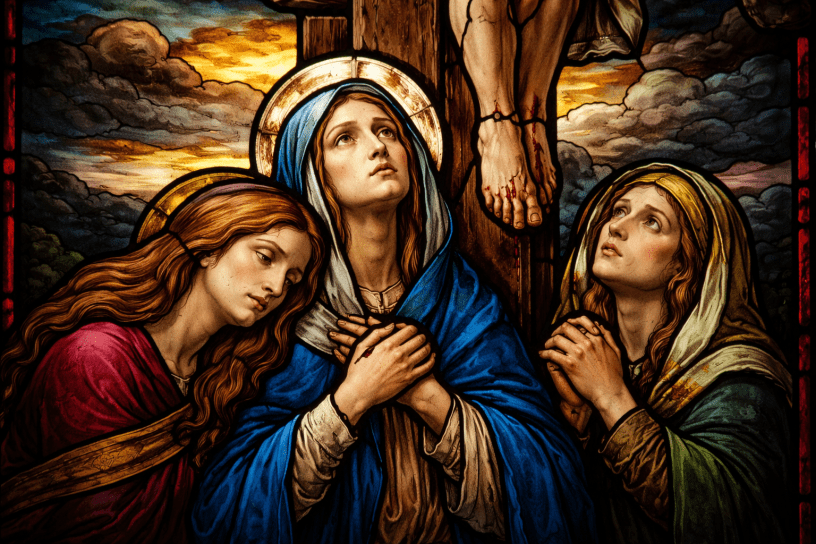
But what is surprising is that a small group of women who followed Jesus chose to stay. Unlike the others, they did not run away and hide. They follow Jesus all the way to the cross and openly mourn, beating their breasts and crying out in pain. And when they arrived at the place of execution, they continued to stay throughout the entire agonizing ordeal, becoming one of the clearest examples of courage and faithfulness in the whole New Testament.
If we are honest, their presence at the cross challenges many of our beliefs about strength, faith, and discipleship. Historically, courage has often been associated with men. When we think of bravery, we usually picture militant men: warriors, soldiers, generals, and kings.
In fact, we have seen a resurgence of this idea in contemporary American culture and even within parts of the Christian church. Some popular podcasters and Christian influencers described “real men” as dominant, aggressive, and controlling. And they are called to stop being sissies by reclaiming strength, by reclaiming this kind of masculine authority and power, often at the expense of women.
But when we look at the cross, the Gospel writers present a very different picture of courage. When following Jesus becomes dangerous, the men run away, but several women stay.
The Gospel of Mark tells us that among them were Mary Magdalene, Mary the mother of James, Joses, and Salome. The Gospel of John adds Mary, the mother of Jesus, and Mary, the wife of Clopas.
In Mark, the author describes the women as followers of Jesus, and this language is important. They were not mere spectators. They were disciples of Jesus: traveling with him, supporting and funding his ministry, and learning from him as their rabbi. And again, when others fled in fear on the way to the cross, when things became dangerous, they kept following him all the way to the end.
This is a portrait of courage. Not dominance, or control, or aggression. But a faithful, courageous presence in the face of fear. And as we look closer at this courage, we see something deeper: that this courageous faithfulness was motivated by deep love.
Courage Rooted in Love
These women didn’t follow Jesus because of what they could get out of it. They didn’t follow because he offered them influence, status, wealth, or power. By the time Jesus reaches the cross, all those things are gone. The crowds have dispersed. The miracles have stopped. And everything Jesus preached about seems to have failed. Yet the women remain.
Why? Because their faith is rooted in a deep love for Jesus himself. Again, their devotion isn’t about what they can gain, but about who they love. This exemplifies what true discipleship looks like. It doesn’t ask, “What do I get from following Jesus?” but rather, “What am I willing to lose because I love Jesus?” In this way, the women show us that real faith is relational, not transactional. Their courage didn’t appear out of thin air; it naturally grew from their relationship with him because they truly loved him.
Remember that in the ancient world, women had very little public authority. Most women did not travel with rabbis and were expected to remain at home in domestic roles, especially those of childbearing age. And their voices were often marginalized in public life.
However, when we read the Gospels, we see Jesus consistently challenging these social norms and breaking these cultural barriers. He talks openly with women, welcomes them among his followers, accepts their financial support, heals them, defends them, and teaches them. Time and again, he highlights the dignity of women and elevates them as examples of faith. As we will see on Easter, women were the first witnesses to the resurrection, the first to meet the risen Christ, and the first to preach the good news, “He is risen!” Throughout all of this, Jesus’ treatment of women was radically counter-cultural.
Why? Because Jesus understood something fundamental about the kingdom of God. Every human being is created in the divine image and has sacred worth. This core truth about humanity cuts through every man-made hierarchy, like gender, race, and social status. Every person carries the divine image of God’s creativity and purpose. And because of that, women mattered to Jesus. Their voices mattered, and their faith mattered.
And this should matter to us also, especially because of the recent resurgence of sexism in extreme parts of American Christianity.
Sexism in the Church and the Dignity of Women
Certain evangelical voices, especially those supporting some form of Christian nationalism, are promoting ideas that would have shocked the early church. Along with arguments that women shouldn’t preach or lead in local congregations, some influential preachers and podcasters in recent weeks have publicly argued that we should repeal the 19th Amendment, which grants women the right to vote, and that the federal government should seize the property of any church that ordains women.
While this may seem extreme, these public figures have large platforms in certain churches and have gained an audience with some pretty powerful people. While they claim that this is what the Bible teaches, these ideas are actually grounded in a vision of militant masculinity that defines strength as domination and control. Once this vision is clear, it is then projected back onto the Bible and used to misinterpret specific passages. This gives divine justification for their oppressive stereotypes and reinforces the idea that this is what the Bible really teaches.
But when we read the Bible carefully, especially the passion narratives in the New Testament, this entire picture falls apart. Again, the male disciples, whom we usually see as strong and brave, run away in the face of danger. Even Peter, who is often seen as the epitome of masculinity, denies Jesus three times. But not the woman. They prove to be the bravest disciples of all because they follow Jesus to the very end.
They also proved to be the strongest because the cross redefines what strength truly is. Real strength isn’t about control or dominance, but about the power of self-sacrificial love, which shows us that domination and control are actually sinful. True strength comes from deep love and is shown in the courage to humbly follow Jesus wherever he leads, even into very frightening places.
Taking all of this into consideration, if we claim to follow Jesus, we cannot build a theology that diminishes the very people Jesus honored and empowered. The kingdom of God does not support systems of domination and inequality. Instead, it challenges and dismantles these systems in ways that restore the dignity of women as beloved children of God and faithful disciples of Jesus.
From Admiring to Following
In fact, the women at the cross, as well as many women in our own congregation, show us something very important: that there is a difference between admiring Jesus and following Jesus. It’s easy to admire Jesus when he is healing the sick and feeding the crowds. It is easy to admire Jesus when he is performing miracles and inspiring hope.
But following Jesus eventually leads us to the cross. And the cross brings us to places where suffering is real. It brings us to places where people are vulnerable. It brings us to moments when doing the right thing may cost us something. And faithful women throughout the history of the Christian church show us what it means to remain with Jesus, to stay rooted in love and compassion in the face of danger, rejection, and intense suffering. To have a faith that is stronger than fear and the compulsion to control through domination.
Living This Kind of Faith
So how might we begin to live this kind of faith today? First, we can honor the women who have shaped our faith with true strength and courage. Most of us can look back and see women who sacrificed for us, encouraged us, prayed for us, and helped us grow into who we are today through times of trial and tribulation. Maybe it was your mother. Maybe your grandmother. Maybe a Sunday school teacher or a mentor who believed in you when you did not believe in yourself.
Think about the women who showed you what it means to follow Jesus by the way they loved you. Take time today to thank God for them. And if you can, reach out and personally thank them. Tell them that their courage and faith shaped your life.
Second, commit to standing courageously and lovingly with the vulnerable. In a few moments, I will invite you to write down a burden that is stirring in your heart because of this message. It might be an injustice that troubles you. It might be a group of people who are hurting. It might be someone who is overlooked or mistreated. Write it down on your bulletin or a small piece of paper. Then place it somewhere you will see it throughout the week. Every time you see it, pray a simple prayer: “Lord, what are you calling me to do about this? Give me the willingness and the courage to follow you, no matter what it costs.” Because sometimes when we hear the whisper, “Someone should do something about that,” it’s the Holy Spirit trying to get you to see that the “someone” is you.
Don’t run away from danger, but courageously walk toward it for the sake of the gospel and those who need help. Be willing to risk your reputation or even your safety to do what is right. This is what real courage and strength look like—not power or domination, but self-sacrificial love.
This is the manuscript for Sermon Five in a Lenten series based on the book, An Unlikely Lent: Extraordinary People of the Easter Story, by Rachel Billups (Nashville: Abingdon Press, 2025). This message was written in conversation with Chapter 5, “Unlikely Courage: The Women at the Cross.”
 Pastor Mark Reynolds