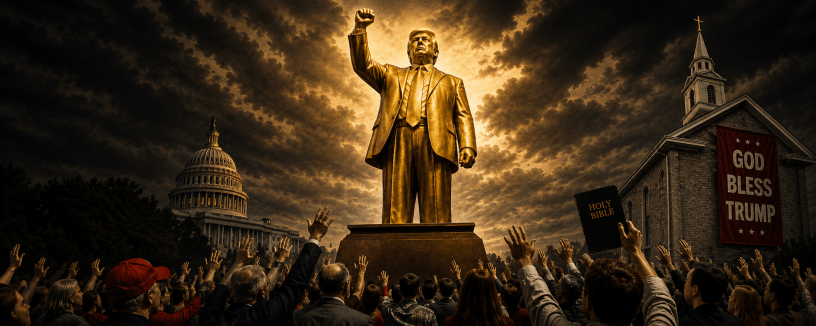
This past week, I watched footage of evangelical Christian leaders gathering around a massive golden statue of Donald Trump at one of his Florida properties. The statue, reportedly more than twenty feet tall and covered in gold leaf, depicted Trump with his fist raised in triumph, while pastors and supporters publicly dedicated it with prayers and religious language. One pastor repeatedly insisted that it was “not a golden calf,” which, frankly, only made the imagery more disturbing because it showed that everyone involved instinctively understood the biblical parallels.
I’ve seen many troubling developments over the past decade as religion and politics have grown increasingly intertwined in America. I’ve watched pastors excuse cruelty in the name of strength, even encouraging unimaginable violence during a prayer meeting at the Pentagon. I’ve watched Christians justify dehumanizing rhetoric toward immigrants, refugees, political opponents, LGBTQ people, and vulnerable communities. I’ve watched conspiracy theories spread through churches more quickly than the teachings of Jesus. I’ve watched political loyalty increasingly resemble religious devotion.
But something about the image of Christians standing around a towering golden statue of a political leader felt especially gut-wrenching, even if it was not entirely surprising, because it gave explicit expression to ideas that had long remained implicit. For years, theologians, pastors, and thoughtful Christians who warned about the idolatrous tendencies surrounding the current administration were often dismissed, mocked, or gaslit as hysterical, partisan, or divisive. Yet now the imagery is no longer subtle. The idolatry has become public, ceremonial, and almost liturgical.
Have we crossed into something evil that previous generations of Christians would have recognized immediately? Not because Christians are participating in politics. Christians should care deeply about public life because the gospel has social and political implications. But this was something else.
Any educated observer with even a small measure of objectivity can see that America today is drifting toward authoritarianism, steadily eroding democratic norms and institutions. Just as troubling, much of this is being given divine legitimacy by an extreme form of “evangelical” Christianity that has sold its soul to a nationalism that is, in fact, anti-Christ. This is not hyperbole. It is an honest description of what is unfolding before our eyes: the weakening of democratic principles and the bastardization of Christianity itself.
As a pastor, theologian, and follower of Jesus, I believe this constitutes a profound betrayal of the gospel of Jesus. I don’t use that language lightly. Using Christianity to sanctify cruelty, domination, exclusion, fear, scapegoating, and the worship of political power is blasphemous. It attributes evil to God and radically distorts the faith once entrusted to the saints.
The Jesus revealed in the Gospels did not gather the vulnerable around Caesar to teach them to trust imperial strength. He proclaimed the kingdom of God. He welcomed strangers and outcasts. He blessed the poor. He confronted religious hypocrisy. He repeatedly warned about the seductive power of wealth and domination. He refused the temptation to rule by coercion or violence. He taught his followers to love their enemies, care for the marginalized, tell the truth, reject fear, and embody a radically different kind of community.
That is why I believe followers of Jesus must urgently and courageously resist the corruptions of Christian nationalism and authoritarian Christianity. While this will require political engagement, it’s not primarily a political task. It’s a theological, pastoral, and spiritual task. And resistance alone is not enough. We must also offer a counter vision.
While Christian nationalism largely ignores the Old Testament prophets and the teachings of Jesus, we must offer a clear and reliable testimony to the gospel. We must return to the prophets. We must point people back to Jesus Christ, not merely as a personal Savior who helps individuals get into heaven when they die, but as Lord of creation, whose teachings reshape every dimension of human life. We must return to the Sermon on the Mount and the vision of Pentecost.
And we must practice these teachings in the local church by building communities of love that reflect the values of the kingdom of God, or as Martin Luther King Jr. called it, “beloved community”—a vision of society rooted not in domination, fear, racial hierarchy, or violence, but in justice, reconciliation, truth, and shared human dignity grounded in the love of God.
Recently, I began reading Building Beloved Community: The Courage to Love in the Face of Tyranny, a book by the United Methodist Council of Bishops. I believe this book is one of the most important theological resources the church currently has for understanding our moment, and I encourage everyone to buy a copy and read it.
In this book, the bishops are both prophetic and pastoral. They clearly identify authoritarianism, nationalism, Christian nationalism, racism, xenophobia, misogyny, and political violence as genuine threats to the gospel and to democratic society. But they do so not from a place of partisan tribalism or ideological rage. They write as pastors seeking to help Christians think faithfully, ethically, historically, and theologically in a dangerous moment.
Over the coming weeks, I want to provide detailed summaries and reflections on this book because I believe the church urgently needs theological clarity right now.
This first post will focus primarily on Part One of the book, which examines authoritarianism, nationalism, and Christian nationalism.
The Central Argument of the Book
The bishops begin by noting that our world is increasingly fragmented. Polarization is dividing nations, communities, churches, and families. Climate change, forced migration, economic inequality, technological manipulation, social media disinformation, and political instability are all fueling widespread fear, anxiety, alienation, and social exhaustion. All of this generates fear and creates fertile ground for authoritarianism.
The bishops argue that authoritarian leaders rise to power by offering certainty amid instability. They promise strength in times of anxiety. They divide society into insiders and outsiders. They scapegoat vulnerable groups. They claim that only they can restore greatness, order, purity, or security.
At its core, authoritarianism is the concentration of power into the hands of leaders or ruling groups who are no longer meaningfully accountable to the people. When power becomes centralized in a single ruler or strongman, it becomes an autocracy.
While some nations have fallen into authoritarianism through sudden revolutions or military takeovers, authoritarianism often grows gradually within democratic societies. It advances by gradually weakening democratic institutions, attacking the free press, undermining confidence in fair elections, intimidating or co-opting civil society, demonizing political opponents, normalizing fear, and destabilizing the very possibility of shared truth.
Historian Timothy Snyder makes this clear in On Tyranny, warning that democratic collapse usually occurs incrementally through normalization rather than through dramatic revolution. Similarly, Anne Applebaum argues in Twilight of Democracy that modern authoritarian movements often thrive less on coherent political philosophy and more on networks of grievance, propaganda, media ecosystems, and personal loyalty structures. The bishops recognize these same patterns emerging globally and, increasingly, within the United States.
Babel Versus Pentecost
In the introduction to Building Beloved Community, the bishops contrast Babel and Pentecost.
Babel represents humanity’s attempt to secure unity, identity, and power apart from God. It is a story of imperial ambition, centralized control, and the human desire to become godlike. The result is fragmentation and alienation.
Pentecost is God’s counter-vision. At Pentecost, people from every nation gather, speaking different languages, yet through the Holy Spirit they are united without losing their distinctiveness. This is crucial. Pentecost is not sameness. It is unity across differences.
That stands in direct contrast to authoritarian movements, which typically seek enforced conformity, ideological purity, and rigid insider-outsider boundaries. The bishops suggest that the church must decide whether to embody Babel or Pentecost.
Wesleyan Holiness and Beloved Community
The bishops root their response deeply in Wesleyan theology.
John Wesley rejected the separation of personal and social holiness. Love of God necessarily expresses itself as love of neighbor. Spiritual formation is never merely private spirituality detached from social ethics.
This matters enormously because, as I argue in my forthcoming book, What Christians Do, many forms of modern Christianity have reduced salvation almost entirely to believing the right things so we can go to heaven, while ignoring systemic injustice, public ethics, economic exploitation, racism, nationalism, and violence.
The bishops insist that discipleship necessarily involves the formation of a beloved community. This includes:
- recognizing the sacred worth of every person,
- welcoming strangers,
- resisting dehumanization,
- protecting vulnerable people,
- and building communities shaped by justice, mercy, truth, and love.
In many ways, this vision directly challenges the fear- and grievance-driven tribalism increasingly shaping American political and religious life.
Christian Nationalism
The strongest and most urgent section of Part One focuses on Christian nationalism.
The bishops define Christian nationalism as the belief that a nation was founded by Christians, exists primarily for Christians, and should privilege one extreme form of Christianity, culturally and politically, to best support its national ideology.
But the bishops argue that Christian nationalism is not truly Christian in any meaningful sense of the gospel. And I agree. Christian nationalism consistently distorts the teachings of Jesus. It often ignores:
- the prophets’ concern for justice,
- Jesus’ commands to love enemies,
- care for immigrants and refugees,
- concern for the poor,
- truthfulness,
- humility,
- mercy,
- and peacemaking.
Instead, Christian nationalism increasingly defines Christianity through:
- power,
- domination,
- nationalism,
- border anxiety,
- patriarchy,
- grievance,
- and fear of cultural change.
The bishops especially criticize white Christian nationalism, which fuses Christianity with white cultural dominance and authoritarian politics. They argue that this movement often presents itself as protecting Christianity while actually distorting it into an ideology of exclusion and power.
In my opinion, this leads to a version of Christianity that is unequivocally anti-Christ.
This is why the golden Trump statue disturbed me so deeply. Idolatry in the Bible is never merely about statues. It’s about misplaced worship. It’s about placing ultimate trust, hope, identity, belonging, and salvation in things like political power rather than in the triune God revealed in Jesus Christ. And that is precisely what we are increasingly seeing.
The bishops argue that Christian nationalism effectively creates an alternative god. It replaces the crucified Christ with a messianic political strongman who promises salvation through domination, exclusion, and war rather than through sacrificial love.
That is not Christianity. That is blasphemy disguised as Christian language.
Faithful Patriotism Versus Nationalism
The bishops go on to make an important distinction between patriotism and nationalism.
Christians may love their country. We may participate in civic life by voting, protesting injustice, and working for the common good. But nationalism becomes spiritually dangerous when the nation becomes absolute.
Christians ultimately belong to the kingdom of God, not to any political party, nation, ruler, or ideology. This means Christians must be able to love their country without idolizing it. We are called to be patriots without becoming nationalists. That distinction feels increasingly urgent right now.
Why This Matters Spiritually
What I appreciate most about the bishops’ work is that they recognize this crisis is ultimately theological.
This is not simply about politics.
It is about worship.
Identity.
Fear.
Truth.
Discipleship.
Imagination.
Authoritarianism functions as a form of idolatry by shifting ultimate trust from God to political power. It asks people to believe that salvation comes through domination, exclusion, force, nationalism, war, and strong leaders rather than through the crucified and risen Christ.
That is why Christians cannot remain silent.
And silence is not neutrality.
The bishops repeatedly emphasize that Christians must resist these corruptions not with hatred or fear, but by embodying an alternative vision grounded in Jesus Christ and in beloved community.
That is the task before the church now.
Not culture war.
Not domination.
Not revenge.
Not partisan tribalism masquerading as faith.
But the difficult, courageous work of truth-telling, repentance, justice, mercy, reconciliation, and beloved community is rooted in the kingdom of God.
In future posts, I plan to continue summarizing the later sections of Building Beloved Community, especially the bishops’ reflections on political engagement, ethical discernment, public theology, and Christian hope.
I’m doing this because I increasingly believe the church in America is approaching a crossroads. And the question before us is not simply political. It is profoundly spiritual:
Will we follow the way of Caesar or the way of Jesus Christ?


What a wonderful uncovering of the crisis moment the church is in today! I can’t wait to read your upcoming book and the critical points that are made within it.
Also, I believe the distinction is that we are called to do, and not just to talk about the crossroads we face especially when those in power seek to recreate political maps to insure “more of the same.” If we sit on the sidelines of do-nothingness, we continue to experience years of our sincere faith being sacrificed on the altar of authoritarianism fueled by bigoted christian Nationalists!!!
LikeLike
Pastor Mark,
Thank you so very much for this! Artie & I have attended “No Kings” rallies, & written to our reps in Congress. We often express our feelings to others as well. Will will do whatever it takes to get to poles & vote when the time comes. Hopefully, congress will still allow elderly people and women to vote by then. We’re in a wildly insane historical time in history. I often pray for world peace and leadership that follows the U.S. Constitution and Ten Commandments. I wish there was more we could do. Where is “We the People” anymore! May the Lord bless and keep us all safe.
Warm regards,
Claudia
PS: Emma should give sermons more often. She gave a wonderful sermon on Mother’s Day. She’s gifted and talented!
LikeLike