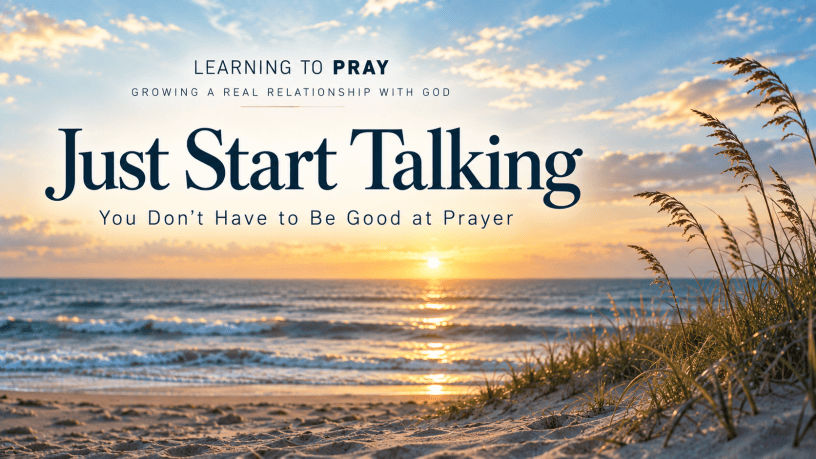
What if a wandering mind, unanswered questions, frustration, or stumbling words aren’t evidence that you’ve failed at prayer? What if that’s exactly where prayer can begin?
Even though I’m a pastor, I still struggle with prayer at times.
There are moments when I feel close to God, when I know exactly what I want to say and the words come naturally. But there are other times when I feel disconnected and struggle to find the right words. Sometimes I can focus, and sometimes my mind wanders. Sometimes I pray because I’m overflowing with gratitude, and sometimes I feel so defeated and worn down that I avoid prayer altogether.
I suspect I’m not alone.
Over the years, I’ve heard people say things like, “Pastor, I wish I knew how to pray,” or “I’m just not very good at praying.” Usually, they mean they don’t know what words to use, don’t feel anything when they pray, or can’t focus. Sometimes they’ve prayed about something for a long time and nothing happened, and now they’re not even sure what they’re doing anymore.
Prayer can become another area of our lives where we feel inadequate.
But maybe we’re asking the wrong question.
You Don’t Have to Be Good at Prayer
What if the problem isn’t that we’re bad at prayer? What if we’ve misunderstood what prayer is about?
What if a wandering mind, unanswered questions, frustration, fumbling words, or even a lack of motivation aren’t evidence that we’ve failed at prayer?
What if that’s exactly where prayer can begin?
One thing I find encouraging is that even Jesus’ disciples didn’t always know how to pray. In Luke’s Gospel, after Jesus finishes praying, one of his disciples approaches him and says, “Lord, teach us to pray.”
Think about that. These were people who left their homes to follow Jesus. They traveled with him, listened to his teachings, watched him heal people, and saw firsthand what a life surrendered to God looked like. Yet after watching Jesus pray, they realized they still had something to learn.
And Jesus doesn’t shame them for asking. He doesn’t suggest that if they were more spiritually mature, prayer would come naturally. He simply teaches them.
That tells us something important: prayer is something we can learn.
James Martin makes a wonderfully simple point in his book Learning to Pray: A Guide for Everyone: prayer is fundamentally about relationship. And if we begin there, it changes how we think about prayer.
Prayer isn’t primarily about mastering a spiritual technique. It isn’t about finding the magic combination of words that will make God give us what we want. And it certainly isn’t about impressing God with how religious we sound.
If prayer is about relationship, we can begin much more simply:
by showing up and talking honestly.
Start Where You Are
Sometimes simply wanting a relationship with God is enough to get us started.
When the disciples say, “Lord, teach us to pray,” that request itself is already a kind of prayer. They want to know God more deeply.
Maybe that’s where you are.
Perhaps prayer has never felt natural to you. Maybe you used to pray more than you do now, but you’re in a season when God seems unusually distant. Maybe you’ve spent years in church and still feel a bit embarrassed when someone asks about your prayer life.
But somewhere inside you there may still be this desire:
God, I want to know you.
And that is enough to begin.
You don’t need a sophisticated theology of prayer. You don’t need to learn a special technique or formula. You don’t need to manufacture a spiritual feeling. You can start where you are, with a desire to connect with God.
When Jesus teaches his disciples to pray, he begins, “Our Father…” Father is certainly not the only image of God in Scripture, and for some people, that image can be difficult because of painful childhood experiences. But Jesus’ point is intimacy.
We aren’t approaching some distant force that must be persuaded to notice us. We’re approaching the God who already knows and loves us as a good parent.
And that means we don’t have to pretend.
God Is Not Threatened by Your Honesty
Nowhere does Scripture demonstrate the honesty of prayer more powerfully than in the Psalms.
Some of us learned early in life that prayer requires us to present ourselves in a certain way. We may be angry, yet we think we’re supposed to appear peaceful. We may be terrified, yet we think we should sound confident. We may be confused, yet we’re reluctant to express doubt. We may even be angry with God, yet we assume that saying so out loud would somehow be disrespectful.
Instead of bringing our true selves to God, we bring the version of ourselves we think God wants to hear.
Then we open the Psalms:
“How long, O Lord? Will you forget me forever? . . . How long will you hide your face from me?”
That doesn’t sound very composed.
The writer of Psalm 13 sounds hurt and frustrated. In the opening verses, he cries out four times, “How long?” He doesn’t begin by finding the perfect words. He begins with how he actually feels. He doesn’t clean himself up emotionally before coming to God or pretend that everything is fine.
He tells God the truth:
This hurts.
I don’t understand.
Where are you?
How long will this last?
And that’s where prayer begins—not with the words we think we should say, but with the truth of where we truly are.
This is one reason I find the Psalms so comforting. They encompass the full range of human emotion: joy, gratitude, and praise, as well as grief, anger, fear, confusion, disappointment, loneliness, and doubt.
We don’t need to protect God from how we really feel.
Prayer Is Where We Stop Hiding
Sometimes we imagine prayer as giving God information, as though God were sitting in heaven, saying, “I had no idea Mark was upset. Thank goodness he told me.”
But if God already knows us completely, honesty in prayer isn’t for God’s benefit.
It’s for ours.
Prayer is where we stop hiding.
It’s where we become aware of what is actually happening inside us and bring it into God’s presence.
And sometimes that can be uncomfortable.
You know how this works. You get home after a long day and don’t really want to be alone with your thoughts, so you turn on the television. Then you pick up your phone and scroll for a while. You check one more email. You find something else that needs to be done.
Anything to keep the noise going.
Then you finally sit down to pray.
The room gets quiet.
And suddenly everything you’ve been outrunning catches up with you.
I’m angry.
I’m afraid.
I’m lonely.
I’m exhausted.
I’m worried about my child.
I don’t know what to do.
I’m angry with God.
All those thoughts can become prayer because God is not threatened by our honesty.
The biblical tradition is filled with people who question God, argue with God, lament before God, and sometimes simply cry out when they don’t know what else to do. Biblical faith is far more emotionally honest than the sanitized version of Christianity we sometimes create.
That matters because relationships cannot deepen without honesty.
Imagine a friendship where every conversation stays on the surface. Someone asks, “How are you?” and you answer, “I’m blessed,” even as your life is falling apart inside.
That isn’t intimacy.
That’s pretending.
And since prayer is a relationship, pretending gets in the way.
God doesn’t need the person you think you’re supposed to be. God wants the person who is actually there.
Prayer Isn’t About Controlling God
Psalm 13 moves from lament—“How long, O Lord?”—to asking for help and eventually to trust.
What’s important is the order.
The psalmist doesn’t begin with trust and pretend the pain isn’t there. He begins with the pain, bringing it into his relationship with God. The lament is prayer. Asking for help is prayer. Trust is prayer.
Once we begin thinking about prayer this way, something else becomes clear: prayer cannot primarily be about getting something from God.
There is nothing wrong with asking God for what we need. Jesus teaches us to do just that. But prayer is more than a list of requests, and it certainly isn’t a technique for controlling outcomes.
We don’t pray hard enough, believe strongly enough, or find the right words to make God arrange the world according to our wishes.
Prayer isn’t about learning to control God. It’s about learning to trust God and be with God in the midst of our actual lives.
God Is Already There
This brings us to something even deeper.
Prayer doesn’t actually begin with us.
Prayer begins with God.
Before you begin praying, God is already present.
Before you find the words, God already knows.
Before you reach toward God, grace has already reached toward you.
Even our desire to connect with God is itself a gift of grace. When we sit down to pray, we aren’t trying to persuade a distant, reluctant God to show up and care about us.
God is already there.
God already cares.
You don’t initiate a relationship with God when you pray. You respond to a relationship God has already established by grace.
I like to think of prayer as less about invoking a spirit and more about waking up to a Presence already present to us.
Over time, that awareness can change us. Maybe not dramatically. We may never have mystical visions or hear mysterious voices. But perhaps one day we look back and realize we aren’t quite as selfish, closed off, or resentful as we once were. Maybe we begin to see other people differently, especially those who are hurting. Maybe we become grateful for things we normally overlook.
These are some of prayer’s greatest gifts.
Five Minutes. One Honest Sentence.
So here is a simple practice you can try this week.
Give God five minutes a day.
And if five minutes feels like too much, start with two.
Don’t worry about creating the perfect setting. You don’t need candles or special music. You don’t need to sit in a particular position. You can pray at home, in your car, at the beach, while walking down the street, or while sipping your morning coffee.
Just show up.
Then begin with one honest sentence:
God, I’m tired.
God, I’m grateful.
God, I’m scared.
God, I’m angry.
God, I need help.
God, I don’t know what to say.
Then keep talking—not the way you think a Christian is supposed to talk, but the way you would talk to someone who loves you deeply and already knows you completely.
And if you run out of things to say, sit quietly.
You don’t have to fill every moment with words. Silence is part of relationships, too. Some days, the most faithful thing you can do is sit for five minutes and say nothing.
The point isn’t to perform.
The point is to be present.
Just Start Talking
Maybe that’s where prayer begins for us—not somewhere above our lives, but right in the middle of them.
With the anxiety you carry.
With the person you’re worried about.
With the gratitude you felt watching the sunrise.
With the question you cannot answer.
With the anger you wish you didn’t have.
With the grief that still catches you by surprise.
With the hope you’re almost afraid to name.
Bring all of that to God. Bring the real you, because that’s the person God already knows and loves.
You don’t have to be good at prayer to pray. You don’t have to have everything figured out or feel especially spiritual. You don’t have to use impressive language or be certain about what you believe at that moment.
If all you can say is, “God, I’m here,” start there.
If all you can say is, “How long, O Lord?” start there.
If all you can say is, “God, I don’t know what to say,” start there.
You don’t have to pretend. You don’t have to find the perfect words. You are already known. You are already loved.
Grace has already reached out to you.
So just start talking.
This is where prayer begins.
Continue the Journey
📖 What Christians Do: Living Like Jesus in a Divided World
What if Christianity were known less by what Christians argue about and more by how we live?
My new book, What Christians Do, explores six practices rooted in the life and teachings of Jesus that can help us become people of greater humility, compassion, courage, justice, and love—especially in a divided world.
Coming October 6, 2026, from Abingdon Press.
Learn More & Preorder What Christians Do
✉️ Get My Free 5-Day Devotional
Want to go deeper? Subscribe to receive my free 5-Day Devotional, along with future articles and reflections on faith, spiritual formation, and learning to live more like Jesus.
Subscribe & Get the Free Devotional

