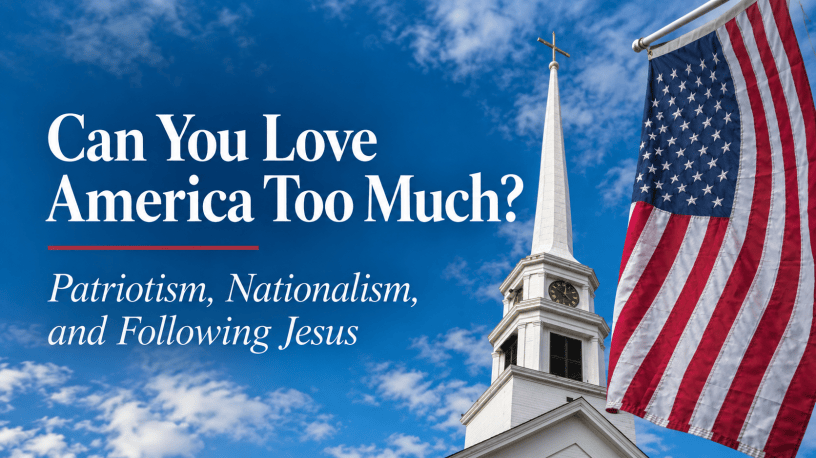
Patriotism, Nationalism, and Following Jesus
Two hundred and fifty years ago this summer, fifty-six men signed a document that began with an extraordinary claim. They wrote:
“We hold these truths to be self-evident, that all men are created equal, that they are endowed…with certain unalienable Rights, that among these are Life, Liberty and the pursuit of Happiness.”
Those words are beautiful. They express the conviction that every human being possesses dignity that government neither creates nor can simply take away. Life. Liberty. The pursuit of happiness. For 250 years, those words have inspired people, not only in this country but around the world, to imagine societies where human beings are free.
As Christians, I think we should give thanks for these rights, which include religious liberty, freedom of speech, representative government, the right to vote, and the ability to criticize our leaders without being charged with treason. We should give thanks for generations of Americans who have sacrificed, sometimes at enormous personal cost, to preserve those freedoms and extend them to others.
Things like this make me love America. After traveling to several countries, especially in Central America, I’m so grateful that I was born here and that my family gets to live here. I love this land and want it to flourish.
Love Without Idolatry
But Christians have always known that loving something and worshiping it are two different things.
That distinction is especially important for Christians because our faith teaches us that nothing—not a nation, a flag, a political party, a president, or even our Constitution—can take the place in our lives that belongs to God alone. That doesn’t mean those things aren’t important. It means they aren’t ultimate.
I think one of the best ways we can celebrate America’s 250th birthday is to give thanks for what is good while also telling the truth about where we’ve fallen short of our highest ideals. That kind of truth-telling is deeply rooted in the Bible’s prophetic spirit. The prophets loved Israel—their people and their faith—and that love motivated them to speak the truth when things went wrong.
Sometimes we struggle to do that with our own country. Discussing our past failures can stir up guilt or shame, or we may worry that focusing on what went wrong somehow cancels out everything that went right. We may even fear that criticizing our history is the same as disrespecting it.
But gratitude and honest self-examination are opposites. In the biblical tradition, they belong together.
The prophetic spirit teaches us that the more deeply we love something, the more willing we should be to speak the truth about it. We look honestly at our past not because we’ve soured on America, but because we love it and want it to live up more fully to its core values.
This matters because, from the beginning, a tension has existed between our ideals as Americans and our lived reality. We declared that all people are created equal while permitting human beings to own other human beings, denying women the right to vote, and displacing native peoples from their lands. Even after slavery ended, Black Americans endured generations of segregation, discrimination, and violence.
Yet those words remained in our Declaration of Independence:
All are created equal.
Because the American story is a human story, it’s neither uninterrupted greatness nor uninterrupted failure. It’s the story of people striving to live up to ideals we’ve never fully realized. Because of that, we’ve needed people in every generation—from abolitionists and suffragists to Martin Luther King Jr. and the civil rights movement—to keep asking the question, “If we truly believe that everyone is created equal, what do we need to change?”
This tension at the heart of America is also embedded in our Constitution. Eleven years after the Declaration of Independence, our founders wrote: “We the People…in Order to form a more perfect Union…”
A More Perfect Union
I love that phrase: more perfect.
Those words acknowledge that our work isn’t finished. Even 250 years later, there’s still more to do.
Rather than pointing out something negative about America, this aspirational mentality is one of its greatest strengths. The founders gave us ideals so we can keep evaluating ourselves and growing.
With this mindset, we can love our country without pretending we’ve always been perfect. We can be proud Americans and still tell the truth.
And this is where our Christian faith becomes especially important, because the prophets of the Bible understood this long before America existed.
The prophet Amos lived in Israel during a period of relative prosperity. The people were deeply religious, gathering for worship, celebrating religious festivals, singing songs, and offering sacrifices. Yet enormous injustice persisted in their society, especially toward the poor and vulnerable.
So Amos delivers this shocking message from God:
“I hate, I reject your festivals; I don’t enjoy your joyous assemblies… Take away the noise of your songs; I won’t listen to the melody of your harps. But let justice roll down like waters, and righteousness like an ever-flowing stream.”
Let Justice Roll Down
Amos isn’t saying worship doesn’t matter. He’s a prophet speaking within Israel’s own faith tradition, calling God’s people back to the covenant they already professed to uphold. His point is that worship becomes empty when it is separated from how we treat people.
God essentially says, I don’t want your songs if you don’t care about justice.
And if Amos were preaching today, he wouldn’t be impressed by how many flags we display in our sanctuaries or how loudly we sing patriotic songs. Rather, he would ask the kinds of questions that prophets always ask:
How are you treating people?
What’s happening to the poor?
What’s happening to the stranger?
Are vulnerable people protected?
Is the truth being told?
Is justice being done?
Thinking about America, it’s wise to remember that God doesn’t care how loudly a nation proclaims itself Christian; God cares about how we treat people.
This prophetic spirit is deeply rooted in the teachings of John Wesley, the founder of the Methodist movement, who taught that love of God can’t be separated from love of neighbor and that personal holiness can’t be separated from social holiness. If my faith doesn’t change how I treat others, something is missing.
And this brings me to an important topic.
Two words we often hear in our culture today are nationalism and Christian nationalism. And I think there’s a lot of confusion about what those terms mean.[i]
So let me try to clarify.
Patriotism Is Not Nationalism
Patriotism is loving your country, being grateful for it, and wanting it to flourish.
But nationalism goes beyond loving your country. It treats a particular vision of the nation as absolute and divides people into loyal friends and dangerous enemies. It then seeks to accumulate unrestrained power to legislate its ideology and criminalize dissent.
That’s very different from patriotism.
When religion is fused with that political ideology, we get what people today call Christian nationalism.
Now, I want to be careful here because Christian nationalism doesn’t simply mean being a Christian who loves America. Nor does it mean someone whose faith influences how they vote. Following Jesus shapes our values, and those values naturally affect how we think about issues like poverty, war, immigration, economics, criminal justice, and every other issue that affects our neighbors.
Christian nationalism is something different.
When Faith Becomes a Tool of Power
Christian nationalism occurs when Christianity becomes fused with national identity and political power. Remember that in our country alone, Christians are divided into literally hundreds of denominations and disagree on a multitude of issues, especially regarding the interpretation of the Bible.
With this in mind, we can see how Christian nationalists come along and declare that only the “real Christians” (meaning those who agree with their group) are “real Americans,” superior to everyone else and deserving of positions of power. This leads to the idea that their specific sect of Christianity should seize total control of American government and culture to impose its particular vision on everyone else.
And they do this by demonizing, disempowering, and silencing anyone who disagrees—often by any means necessary.
This is why Christian nationalism is not actually Christian.
It takes the name of Jesus and attaches it to what Jesus repeatedly rejected: the worship of power and the pursuit of control.
To be clear, this temptation doesn’t belong exclusively to one political party. It can manifest among Republicans and Democrats, among conservatives and liberals, because the temptation to worship power is as old as humanity.
In fact, it’s one of the three temptations Jesus faced while he was fasting in the desert, when the devil showed him all the kingdoms of the world and said:
“I will give you all their authority and splendor…if you worship me.”
Because this is a universal temptation, every political movement can become convinced that if only our people had enough power, if we could just silence our opponents, defeat our enemies, and control the institutions, we could finally force the world to become what we think it ought to be.
And Christians must resist that temptation wherever we encounter it—including in ourselves.
Why?
Because Jesus gave us a completely different vision of power.
After rejecting the devil’s offer by saying, “Worship the Lord your God and serve him only,” he went on to teach his disciples about a different kind of kingdom and a different kind of power.
When his disciples were arguing about status and greatness, Jesus said to them:
“You know that the rulers of the Gentiles lord it over them, and their great ones are tyrants over them. It will not be so among you, but whoever wishes to be great among you must be your servant . . .” (Matthew 20:25–26 NRSV)
Read that last sentence again:
“It will not be so among you.”
Not So Among You
Jesus is not ignorant. He knows how the world works. People acquire power and then use it to dominate others. Nations do it, political institutions do it, and, yes, religious institutions do it as well.
But Jesus looks at his disciples and says:
“It will not be so among you, but whoever wishes to be great among you must be your servant . . .”
That’s Jesus’ definition of greatness.
The kingdoms of this world pursue greatness through domination, but Jesus redefines greatness as service. The one we proclaim as LORD and King assumes the posture of a slave to wash his disciples’ feet. He touches the untouchable, shows compassion for outsiders, tells stories that turn enemies into heroes, and commands us to love and pray for those who persecute us. He even endures a torturous death on a cross rather than using his power to destroy those who crucify him.
Consider the contrast.
Christian nationalism asks, “How can Christians take back control?”
Jesus asks, “How can I give myself away?”
Nationalism asks, “Who is a real American?”
Jesus asks, “Who is truly my neighbor?”
Nationalism fears losing power, while Jesus gives power away in love.
And if we’re Christians, Jesus is our standard.
Not Republicans or Democrats.
Not conservatives or liberals.
Jesus.
And when Jesus becomes the standard, we begin to imagine a different kind of kingdom, one that more closely resembles what Martin Luther King Jr. called the “beloved community.”
Beloved Community
A beloved community is built on love rather than fear, on participation rather than concentrated power, on welcome rather than exclusion, and on the recognition that even strangers—even enemies—are our neighbors.
If we follow Jesus, we understand that this is not a philosophy of weakness but a different conception of power.
The world says power is the ability to make others do what you want, but Jesus says power is the ability to love.
The world defines greatness as superiority over others, but Jesus defines greatness as serving “the least of my brothers and sisters” (Matthew 25:40).
The world says to defeat and punish your enemies, but Jesus says to love them.
And just to be clear: loving our enemies doesn’t mean pretending that injustice doesn’t matter. The prophets won’t allow us to do that. Neither will Jesus.
Love sometimes requires confrontation. It certainly requires us to tell the truth, protect the vulnerable, and resist evil. But the Christian goal is never to seek vengeance or destroy people. Rather, it’s redemption, reconciliation, and justice working together in a community of love.
So what would it look like for Christians to love America in a way shaped by Jesus?
A Patriotism Shaped By Christian Values
I think that patriotism shaped by Jesus looks like loving America enough to tell the truth about its successes and failures in realizing its democratic values. It gives thanks for what’s right and confesses what’s wrong.
It protects voices of dissent because, for freedom of speech and religion to be real, they can’t apply only to one political or religious group.
Christian patriotism refuses to demonize our neighbors and rejects political violence. It cares for the poor and the vulnerable. It welcomes disagreement without making anyone a mortal enemy. It holds leaders accountable, regardless of their political party. And it keeps working toward liberty and justice for everyone.
That means Christians ought to be able to disagree politically without calling into question one another’s humanity.
We ought to be able to say, “I think you’re wrong,” without saying, “You’re evil.”
We ought to be able to lose an election without believing the country is lost, and we ought to be able to win an election without believing God has given us permission to dominate the opposing party.
Perhaps most importantly, we need to remember that no political victory can bring the kingdom of God, and that our deepest identity isn’t American but Christian.
In other words, our ultimate allegiance isn’t to a nation but to Christ.
Paradoxically, I think this frees us to love our country more fully because I don’t have to pretend America is perfect to love it. I don’t have to defend everything America has ever done. I don’t have to believe God loves Americans more than anyone else. I don’t have to fear people who are different from me.
And I don’t have to place the impossible burden of saving the world on a president, a political party, or a nation.
I already have a Savior, and his name is Jesus.
Our Highest Allegiance
So here we are, 250 years after the signing of the Declaration of Independence. Our ancestors declared that all people are created equal and later spoke of forming “a more perfect Union.” The prophets dreamed of justice rolling down like waters, and Jesus taught us that greatness lies not in dominating others but in serving them.
So maybe as we celebrate America’s 250th birthday this year, the most important question for Christians isn’t “Is America great?” but “Are we loving our neighbors as Jesus has loved us?” which is the only thing that can truly make our nation great.
This is the most important question because it flows directly from the greatest commandment: to love God with our whole being and to love our neighbor as we love ourselves.
Are we telling the truth?
Are we protecting the dignity of every person?
Are we doing justice?
Are we caring for the poor and vulnerable?
Are we treating strangers as neighbors?
Are we becoming the loving community Jesus called the kingdom of God, or are we building a kingdom where we get to be king?
After 250 years, the work isn’t finished. A more perfect union is still something we’re becoming. And Christians have the freedom to participate in that work—not because we believe America is the kingdom of God, but precisely because we know it isn’t.
So, by all means, love your country . . . but don’t worship it.
The Constitution is not our Bible.
The flag is not our cross.
And America is not the kingdom of God.
Because we know that, we’re free to truly love America without making it an idol. We can give thanks for its gifts without denying its failures, and we can celebrate its progress without pretending the work is finished.
We can join in the work of forming a more perfect union—not because America is our highest allegiance, but because Jesus calls us to love our neighbors, seek justice, tell the truth, and work for the good of all.
As we do, may we never forget the words of the prophet:
“Let justice roll down like waters, and righteousness like an ever-flowing stream.”
As we look ahead to the next 250 years, may that be the gift the church offers this land we love.
Continue the Journey
If this message resonates with you, you may also enjoy my book:
📖 What Christians Do: Living Like Jesus in a Divided World
What if Christianity were known less by what Christians argue about and more by how we live?
My new book, What Christians Do, explores six practices rooted in the life and teachings of Jesus that can help us become people of greater humility, compassion, courage, justice, and love—especially in a divided world.
Coming October 6, 2026, from Abingdon Press.
Learn More & Preorder What Christians Do
✉️ Get My Free 5-Day Devotional
Want to go deeper? Subscribe to receive my free 5-Day Devotional, along with future articles and reflections on faith, spiritual formation, and learning to live more like Jesus.
Subscribe & Get the Free Devotional
[i] For a more extensive but excellent treatment of this topic, see The United Methodist Church Council of Bishops, Building Beloved Community: The Courage to Love in the Face of Tyranny (Nashville: Abingdon Press, 2025).

