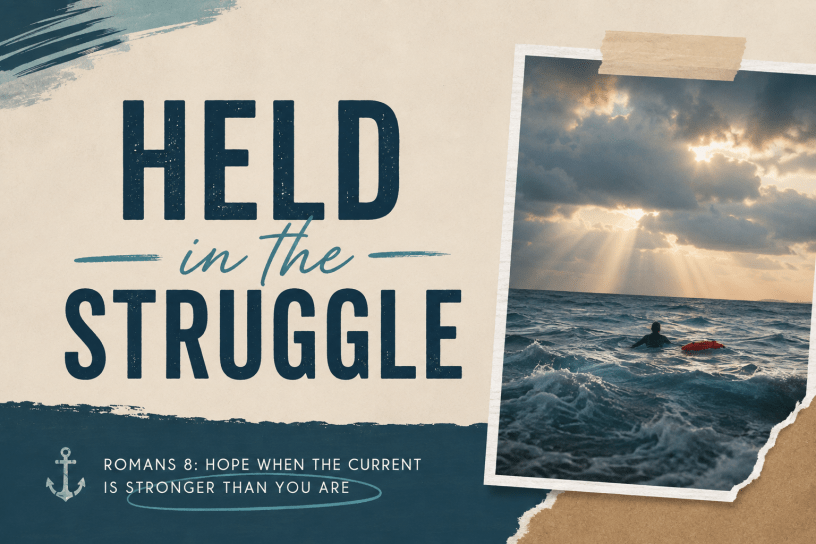
Have you ever walked into the ocean, stood there for a while, enjoying the water, and then looked back toward shore only to realize you had drifted fifty yards from where you started?
You weren’t trying to move. You weren’t even aware you were moving. The current was simply working beneath the surface, slowly pulling you away from where you thought you were standing.
Life can feel like that.
We make a sincere commitment to be more patient. We pray about it, mean it, and for a while we may even think we are making progress. Then someone says the wrong thing at the wrong moment, and suddenly the old anger rushes back. We decide to stop worrying and trust God. We hand our anxiety over to God on Sunday morning, but by Tuesday afternoon our minds are racing again. Or maybe we think we have forgiven someone and moved on, only to find that one careless comment can reignite feelings we thought we had left behind.
There are currents in life that are stronger than we are, and some of them move around us while others move within us.
The Apostle Paul understood this, and instead of pretending otherwise, he told the truth.
The Apostle Who Told the Truth
In Romans 7, Paul writes with an honesty that is almost startling. He describes the experience of knowing what is right, sincerely wanting to do it, and then discovering that he still does the very thing he hates.
In other words, Paul discovered something most of us eventually realize about ourselves: knowing better doesn’t always mean doing better.
We can understand something intellectually yet still struggle to live it. We can sincerely want to change yet still find ourselves returning to old habits. We can love God and desire to follow Jesus yet still discover patterns of fear, anger, selfishness, resentment, or anxiety operating beneath the surface.
Paul’s confession is not that of someone who has given up. It is that of someone who has stopped pretending.
That distinction matters because one of the most damaging lies shame tells us is that struggling with something makes us hypocrites. But struggling and pretending are not the same thing.
Hypocrisy hides the struggle and creates the illusion that everything is fine. Faithfulness brings the struggle into the light, allowing God’s grace to meet us there.
Christian faith has never been about becoming the kind of person who no longer struggles. It is about becoming the kind of person who can speak the truth about the struggle, receive grace in the midst of it, and keep taking the next faithful step.
This is why sanctification—the lifelong process of becoming more like Christ—is a process. Grace changes us, but most of that change happens slowly as we learn to cooperate with the Spirit and practice a new way of life.
And sometimes, even after years of growth, we realize the current is still there.
The World That Groans
But Paul doesn’t limit his honesty to the struggle within us. When he turns to Romans 8, he widens the frame and describes something much larger.
He says that the whole creation is “groaning” as if in labor pains, waiting for something new to be born.
That’s a powerful image because it reminds us that not everything wrong in our lives can be fixed by trying harder, thinking more positively, or becoming more spiritual. Some of the currents pulling against us are bigger than we are, because we live in a world that is not yet what God intends it to be.
Bodies get sick. Relationships fracture. The people we love make destructive choices, and sometimes there is nothing we can do to stop them. Communities are wounded by poverty, violence, hatred, and injustice. Hurricanes don’t ask permission before destroying homes. Grief doesn’t follow a convenient schedule, and death doesn’t wait until everyone is ready.
Paul doesn’t gloss over any of this with religious clichés. He doesn’t tell people who are suffering that everything happens for a reason. He doesn’t suggest that if they simply had enough faith, they wouldn’t hurt so much. He doesn’t tell them to smile, choose joy, and move on.
Instead, Paul says that the entire creation groans. And then he says we groan too.
Groaning isn’t the opposite of faith. Sometimes it is one of the most honest expressions of faith, because we groan precisely because we know things are not supposed to be this way. We have experienced enough love to know what hatred destroys. We have seen enough beauty to recognize what violence takes from us. And we have caught enough glimpses of God’s kingdom to know that suffering and death cannot be God’s final word.
In that sense, our grief can become a form of protest against everything that diminishes life and love.
We groan because somewhere deep within us, we still long for God’s new creation.
When Words Run Out
And this is where Romans 8 becomes especially beautiful.
Paul understands that our suffering sometimes reaches a point where words fail us. Sometimes we are so frightened, exhausted, confused, or heartbroken that we don’t even know what to pray.
Should I ask God to change this situation?
Should I ask God to change me?
Should I pray for the strength to accept what I cannot change?
Sometimes we simply don’t know, and Paul says that even there we are not alone.
“The Spirit helps us in our weakness,” Paul writes in Romans 8:26, because “we do not know what we ought to pray for.” He then offers us this remarkable image of the Spirit interceding for us with groans too deep for words.
Think about what that means.
At the very moment we may feel spiritually inadequate because we don’t know what to say to God, the Spirit is already present within us. God isn’t standing at a distance, waiting for us to compose the right prayer. God meets us in the confusion and carries what we cannot put into words.
Our tears, silence, and groaning can become prayer because the Spirit is present in them all, carrying our deepest longings into the heart of God.
This means your relationship with God ultimately does not depend on the quality of your prayer life. You don’t have to be eloquent. You don’t have to manufacture gratitude you don’t feel or find a spiritual lesson in every painful experience. Sometimes faith is simply showing up before God exactly as you are and trusting that grace is already there.
And when you don’t have the strength to hold on to God, you can trust that God is still holding on to you.
What “All Things” Actually Means
A few verses later, Paul offers us one of the New Testament’s most beloved—and most frequently misunderstood—passages:
“We know that all things work together for good for those who love God, who are called according to his purpose” (Romans 8:28).
Unfortunately, Christians sometimes use this verse as though Paul were saying that everything happens for a reason or that everything that happens is somehow good because God caused it.
But Paul has just spent an entire chapter talking about suffering, groaning, weakness, and a creation waiting to be healed. It would make little sense for him to suddenly turn around and tell us that all of those painful things are actually good.
They aren’t.
Cancer isn’t good.
Abuse isn’t good.
Violence isn’t good.
The death of someone we love isn’t good.
And when we use Romans 8:28 to rush grieving people past their pain or to explain away tragedy, we can actually make their suffering worse.
Paul is offering us something far more hopeful than the idea that everything happens for a reason. He tells us that God is at work in everything.
No current is so strong, no suffering so deep, and no failure so final that it can place us beyond God’s healing and redeeming love.
This doesn’t mean God causes everything that happens to us. It means that whatever happens to us, God refuses to abandon us.
God can bring compassion from pain because those who have suffered often become especially sensitive to others’ suffering. God can bring courage from fear because we sometimes discover strength we didn’t know we possessed until we have to use it. God can bring community from loneliness when our wounds become places of connection with others who have suffered. And even in the midst of loss, God can slowly teach us to love more deeply.
None of that makes the suffering good.
It means grace is stronger than suffering.
We don’t have to call the broken things in our lives good in order to believe that God can still work in the midst of them.
No Condemnation, No Separation
This brings us to the two great promises that hold Romans 8 together.
The chapter begins with these words:
“There is therefore now no condemnation for those who are in Christ Jesus” (Romans 8:1).
And it ends with Paul’s declaration that neither death nor life, neither angels nor rulers, neither things present nor things to come, nor powers, height, depth, nor “anything else in all creation” will be able to separate us from the love of God in Christ Jesus (Romans 8:38–39).
Notice what happens between those two promises.
There is struggle.
There is suffering.
There is waiting.
There is weakness.
There is groaning.
There are moments when people don’t even know how to pray.
Paul never promises that following Jesus will free us from any of this. Instead, he gives us something deeper: the assurance that nothing can separate us from God.
No condemnation at the beginning.
No separation at the end.
And grace holds everything in between.
Whatever you are carrying today—an old habit that has returned, an anxiety you thought you had overcome, a relationship you cannot repair, a grief that refuses to follow your timetable, or even a silence from God you cannot explain—don’t let shame convince you that your struggle means God has abandoned you.
Tell the truth about where you are.
Ask for help when you need it.
Take the next faithful step you can take.
And when the pain is something you cannot fix, give yourself permission to groan.
Because sometimes the current really is stronger than you are.
But the good news of Romans 8 is that you are not being asked to survive the current by yourself.
The struggle is real.
But the Spirit is present.
And nothing—absolutely nothing—can separate you from the love of God.
If you’re wrestling with faith, struggling through a difficult season, or simply trying to understand what it means to follow Jesus in the middle of real life, I hope you’ll keep exploring with me. Christian faith isn’t about pretending we have everything together. It’s about learning to trust grace, practice the way of Jesus, and discover that God is already present—even in the struggle.
Continue the Journey
📖 What Christians Do: Living Like Jesus in a Divided World
What if Christianity were known less by what Christians argue about and more by how we live?
My new book, What Christians Do, explores six practices rooted in the life and teachings of Jesus that can help us become people of greater humility, compassion, courage, justice, and love—especially in a divided world.
Coming October 6, 2026 from Abingdon Press.
Learn More & Preorder What Christians Do
✉️ Get My Free 5-Day Devotional
Want to go deeper? Subscribe to receive my free 5-Day Devotional, along with future articles and reflections on faith, spiritual formation, and learning to live more like Jesus.

